History
January 11, 2024 — Lloyd Billingsley
Back in 2021, Joe Biden referred to the events of January 6 as “the worst attack on our Democracy since the Civil War.” The Delaware Democrat ignored Pearl Harbor, 9/11, and the attack on the U.S. Capitol on November 7, 1983. The “Armed Resistance Unit” planted a bomb in the Capitol, the Senate document “Bomb Explodes in Capitol” explains, “in retaliation for recent U.S. military involvement in Grenada and Lebanon.”
»
January 7, 2024 — Scott Johnson
Henry Wallace! I have long thought that Roosevelt’s replacement of Wallace with Truman on the Democratic ticket in 1944 provided irrefutable proof that God looks out for the United States. Wallace was a fool who would have altered the course of history very much for the worse if he had succeeded Roosevelt to the presidency in 1945 instead of Truman. Among other evidence of Wallace’s foolishness, one thinks of Wallace’s
»
January 6, 2024 — Lloyd Billingsley

“Ex-CIA analyst says intel agencies to be politically active again in 2024 election: ‘Significant problem,’” proclaimed the January 2 Fox News headline. The former CIA analyst is Georgetown professor John Gentry, who cites “ideology driven analytic errors” such as diversity, equity and inclusion policies. According to Gentry, Bill Clinton launched the DEI policy, formally established by an Obama executive order in 2011. Gentry flags former CIA boss John Brennan and
»
January 1, 2024 — Scott Johnson

Cliff May is founder and president of the Foundation for Defense of Democracies (FDD) and a columnist for the Washington Times. He is a veteran reporter, foreign correspondent, and editor for the New York Times and other publications. Cliff’s current column is “Restoring deterrence” (at FDD, where it is posted with links). Cliff has kindly given us his permission to post his columns on Power Line. He writes at year’s
»
December 29, 2023 — John Hinderaker

Nikki Haley made one of the few real blunders of the GOP primary season when she was asked at a New Hampshire town hall, “What was the cause of the United States Civil War?” For a Republican, this shouldn’t be a tough question. The Republican Party was founded mostly to oppose slavery. But Haley equivocated, in rather weird fashion: The cause of the deadliest conflict in American history, she said,
»
December 26, 2023 — John Hinderaker
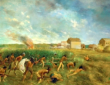
In 1862, Dakota Indians went on a mass murder spree, butchering more than 600 innocent whites, mostly women and children. The Indians murdered babies, beating their brains out and nailing them to trees. They tortured children. They engaged in gang rape on a mass scale. Their rampage was enabled by the fact that many Minnesota men were away, fighting in the Civil War. That slaughter was the worst massacre by
»
December 22, 2023 — Scott Johnson
A friend asked me to recommend a book about Whittaker Chambers as a Christmas gift for her smartly conservative daughter several years ago. Chambers stands at the center of an incredible drama and several fantastic books about him. There is still much to be learned from him and his case. Here I revisit and expand the list with a little help from the eminent historian Harvey Klehr: 1. Witness is
»
December 21, 2023 — Scott Johnson

Robert S. Wistrich was the Neuburger Professor of European and Jewish history at the Hebrew University of Jerusalem and the director of the university’s Vidal Sassoon International Center for the Study of Anti-Semitism. He may also have been the leading academic authority on anti-Semitism. Witness his histories A Lethal Obsession: Anti-Semitism From Antiquity to the Global Jihad (2010) and From Ambivalence to Betrayal: The Left, The Jews and Israel (2012).
»
December 18, 2023 — Lloyd Billingsley

RFK Jr. is in the running for president of the United States, the office his father RFK might have won if he had not been assassinated on June 6, 1968. RFK Jr.’s uncle JFK did gain election to the White House before he was shot dead on November 22, 1963. That launched a murder mystery that continues to this day. Readers can get a fresh perspective from Peter Collier, co-author
»
December 17, 2023 — John Hinderaker

Admiral Horatio Nelson is one of the greatest heroes of British history. With the possible exception of Wellington, no one contributed more to winning the Napoleonic Wars. Nelson’s death at Trafalgar, his greatest victory, holds a place in British history analogous to that of Lincoln at the end of the Civil War. But in recent years, Nelson has come under attack, and activists have urged that statues of him be
»
December 12, 2023 — Scott Johnson

I am grateful to Lloyd Billingsley for his account of Edward Gibbon’s encounter with Muhammad in the pages of The History of the Decline and Fall of the Roman Empire via Robert Spencer’s The History of Jihad: From Muhammad to ISIS. This is nothing more than a long footnote to Lloyd’s post for readers who might be unfamiliar with the text of Gibbon’s monument to posterity or interested in a
»
December 7, 2023 — John Hinderaker
When liberals began their war on public monuments a few years ago, we were told that only statues of Confederate generals would be dismantled. Of course that turned out not to be true. While slavery is the purported justification for these erasures of history, even monuments to Abraham Lincoln have not been immune. Now, New York City–having, apparently, no larger issues to address–is considering tearing down statutes of George Washington,
»
November 30, 2023 — Scott Johnson

Former Secretary of State Henry Kissinger has died at 100. The New York Times obituary by David Sanger is posted here. Sanger’s obituary links to the statement announcing Kissinger’s death by his consulting firm. What a monumental American life he led. Ah, yes, the Times. In 2011 the Times Book Review featured Kissinger’s laudatory review of the new biography of Bismarck by Penn’s Jonathan Steinberg on page one. On my
»
November 26, 2023 — Scott Johnson

In this morning’s Weekend Beacon email Vic Matus directs the attention of readers to Andrew Roberts’s “monumental essay comparing Hamas with the Nazis. In many ways, Hamas comes out worse.” However, President Biden is doing his best to complicate Israel’s effort to eliminate Hamas and impose his “two-state” fantasy on the Israelis despite the glaring absence among Palestinian Arabs of a market for peace. Take Hamas — please: The sheer
»
November 26, 2023 — Scott Johnson

I was surprised to read what I thought was an exceedingly fair and illuminating review of two new books on Friedrich Hayek in the current (December 7) issue of the New York Review of Books. The review is by the financial historian Edward Chancellor. In “The Naturalist” he takes up Hayek: A Life, 1899–1950, by Bruce Caldwell and Hansjoerg Klausinger, and Liberalism’s Last Man: Hayek in the Age of Political
»
November 23, 2023 — Lloyd Billingsley

Sixty years ago this week, on November 22, 1963, President John F. Kennedy was gunned down, but the family’s political odyssey did not end there. JFK’s brother Robert F. Kennedy, who had served as attorney general, made a run for the White House but on June 5, 1968, but Jordanian immigrant Sirhan Sirhan shot RFK dead. That raised expectations for Sen. Edward “Ted” Kennedy. In July of 1969, the “boiler
»
November 23, 2023 — Steven Hayward
It is just me, or did the 60th anniversary of the assassination of John F. Kennedy pass yesterday with much less commemoration than usual? You’d think an anniversary of this sorry day ending in a zero would have merited special closing segments on the evening network news (NBC Evening News chose instead to run a closing puff piece on a Napa Valley winery), covers or special commemorative editions of the
»
