This week’s spotlight on new books about the Declaration of Independence features Hilldale College historian Bradley Birzer, whose book is The Declaration of Independence: A Radical Experiment in Liberty, just out last month from Stone House Press.
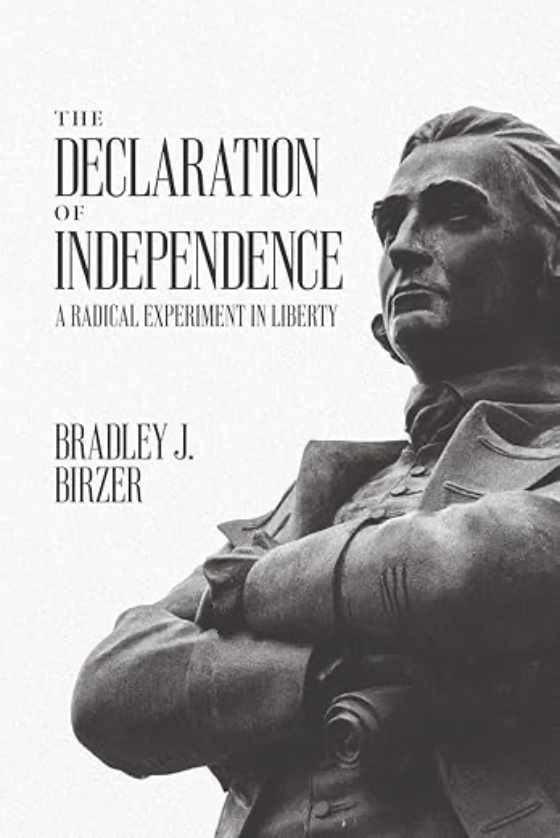 Prof. Birzer’s book has a somewhat shorter time frame than some of the other books we have discussed in this series, which often take the run-up to the Declaration back to the 1760s if not all the way back to classical antiquity, and while Birzer recounts many of the distant antecedents of the Declaration (most especially Cicero), the heart of the book looks most closely at the years from 1774 through 1776, and ends with useful chapters on the structure of the Declaration, and a review of the reaction to the Declaration right after it burst on the scene in that fateful summer.
The book is relatively compact at about 250 pages. It is an eclectic work that attempts to synthesize a number of competing though by no means mutually exclusive interpretations of the Declaration. Early in the book he allows that, “I have found much to admire among the classical Republicans, the Neo-Whigs, the classical liberals, the Lockeans, the Voeglinians, the Jaffaites, the Straussians, the imperial school, the symbols school, etc. Though I most closely identify with the classical Republicans, my approach to the American Revolution is, to be certain, rather eclectic.”
Along the way, you will learn some fun details, such as the fact that the famous signatures on the Declaration weren’t actually affixed to the document until August 2nd, rather than on July 4th as we otherwise assume. His conclusion notes that the Declaration was controversial and attracted critics from the moment the ink dried, but thinks, “Theologically, what Christianity proclaimed in terms of human dignity, the Declaration of Independence proclaimed in terms of political dignity.”
I ask him about this statement in our conversation to follow about his highly readable book, which joins a list of his titles including a full scale biography of Russell Kirk, a biography of Charles Carroll, the lone Roman Catholic signer of the Constitution, two books on J.R.R. Tolkien, and, perhaps most unexpected, a biography of Neal Peart, the late great drummer for Rush. I neglected to ask him if he might consider a biography of Peart’s successor, Anika Nilles, just now beginning a revival tour with Rush. But this just might be the impetus for us to do our long promised/threatened podcast on progressive rock (Brad is a fellow fan, and has long argued that much of progressive rock is hardly “progressive” at all in the current mis-use of that term, but is in fact quite conservative in many ways).
As usual, listen or download here, or at Ricochet or wherever you source your favorite podcasts.
Proudly displaying my copy.
