Supreme Court
December 8, 2025 — John Hinderaker
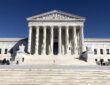
Today the Supreme Court heard arguments in Trump v. Slaughter, perhaps the most important case to come before the Court this term. The case tests the constitutionality of the “independent agencies” that Congress has established over the years–independent, because their commissioners are not under the control of the president. The case arose when President Trump fired FTC Commissioner Rebecca Slaughter, not for cause, as authorized by the FTC statute, but
»
December 7, 2025 — John Hinderaker

On the first day of his second term in office, President Trump issued an executive order directing that children of illegal aliens who are born in the United States are not citizens, and will not be treated as such. This order (like many others) was greeted with outrage in polite society. It has widely been asserted that the 14th Amendment plainly provides birthright citizenship to all who are born here,
»
November 8, 2025 — John Hinderaker

A rogue Democratic Party judge in Rhode Island, John McConnell, ordered the Trump administration to continue fully funding the food stamp program, even though Congress has not appropriated the money to do so. The order, absurd on its face, is already causing chaos. The administration appealed the order to the First Circuit Court of Appeals in Boston, which denied the administration’s request for a stay of McConnell’s order pending the
»
November 6, 2025 — John Hinderaker

Today the Supreme Court issued an order in Trump v. Orr, the case that challenges Trump’s executive order to the effect that a person’s sex as shown on his or her passport will be the sex at birth. This order was challenged in the federal court in Massachusetts, and a Democratic Party judge issued an injunction barring implementation of the order while the case proceeds through the federal courts. This
»
November 4, 2025 — John Hinderaker

I wrote here and here about the federal lawsuit that challenges President Trump’s authority under the International Emergency Economic Powers Act to impose most of his tariffs, including his worldwide “reciprocal” tariffs. The case, V.O.S. Selections, Inc. et al. v. Trump, originated in the Court of International Trade, which held 3-0 that the challenged tariffs were not authorized by Congress. That decision was upheld on a 7-4 vote by the
»
October 8, 2025 — Scott Johnson

I wrote about Minnesota’s statutory ban on so-called “conversion therapy” in columns for the Free Beacon and Alpha News. As it applies to minors, the law bans therapy “that seeks to change an individual’s sexual orientation or gender identity, including efforts to change behaviors or gender expressions…” If a teenager is troubled by the feelings that conflict with his sex and wants to mitigate them or reconcile himself to his
»
October 3, 2025 — John Hinderaker

The Democratic Party has engaged in relentless judge shopping to bring its usually-frivolous cases against the Trump administration before loyal judges. The main purpose of this strategy is not to achieve ultimate victory in the lawsuits, but rather to generate headlines in Democratic Party newspapers like the New York Times and the Washington Post that will make it seem that the administration is acting lawlessly. The object is political, not
»
September 26, 2025 — John Hinderaker

The respective powers of the President and Congress with regard to spending have been a subject of debate since at least the 1970s. The issue has heated up under the Trump administration, as, through DOGE and other initiatives, the administration has tried to put the brakes on wildly out of control spending under the Biden regime. One of the lawsuits that has arisen in that context is DEPARTMENT OF STATE,
»
September 23, 2025 — John Hinderaker

We have been following the cases that address the president’s control over the executive branch under Article II of the Constitution. By statute, Congress has tried to limit the president’s powers, most notably by establishing “independent” agencies that are not fully under the president’s control. The constitutionality of such agencies has always been doubtful, but in Humphrey’s Executor v. United States, 295 U. S. 602 (1935), the Court upheld the
»
September 9, 2025 — Scott Johnson

I have written several posts on California Federal District Judge Maame Ewusi-Mensah Frimpong’s temporary restraining order more or less preventing ICE from operating in California’s Central District — the district covering the seven counties of Los Angeles, Orange, Riverside, San Bernardino, San Luis Obispo, Santa Barbara, and Ventura. The counties’ population of nearly 20 million people is the largest of any federal judicial district in the country. I wrote about
»
September 8, 2025 — Bill Glahn

Newsweek reports, Supreme Court hands Donald Trump new win. You will recall this case, The Supreme Court handed President Donald Trump’s administration another win on Monday, as it cleared the way to allow sweeping immigration operations in Los Angeles. The court overturned a judge’s restraining order which prevented federal agents from stopping people solely based on their race, language, job or location. When the district judge’s original decision came out,
»
August 22, 2025 — John Hinderaker

Activist Democratic Party judges have done everything possible to throw monkey wrenches into Trump administration initiatives. In many instances, they have issued orders purporting to block executive actions without even hearing from the administration. I haven’t tried to keep count, but I think most of those orders have been stayed or reversed on appeal. But Democratic Party judges are not easily deterred. In several cases, they have violated the rule
»
August 11, 2025 — Scott Johnson

Last month California Federal District Judge Maame Ewusi-Mensah Frimpong issued a temporary restraining order more or less preventing ICE from operating in California’s Central District — the district covering the seven counties of Los Angeles, Orange, Riverside, San Bernardino, San Luis Obispo, Santa Barbara, and Ventura. The counties’ population of nearly 20 million people is the largest of any federal judicial district in the country. I wrote about Judge Frimpong’s
»
July 14, 2025 — John Hinderaker

As Bill Glahn noted earlier, President Trump won a victory today in the Supreme Court. The case grows out of the administration’s attempt to shut down, or at least cut back on, the Department of Education. Toward that end, Secretary of Education Linda McMahon laid off something like half of the Department’s employees, and reassigned some of the Department’s functions to other agencies. That resulted in a lawsuit in the
»
July 14, 2025 — Bill Glahn
First it was the State Department. Now this from The Hill newspaper, Supreme Court allows Trump to resume Education Department layoffs. Some 1,400 workers are involved. The Hill explains, Since entering office, the administration has sought to lay off half of the Education Department’s workforce and move some of the agency’s core functions, such as managing student loans, to other federal departments. U.S. District Judge Myong Joun blocked those efforts
»
July 12, 2025 — Scott Johnson

A federal judge in Los Angeles — Central District Judge Maame Ewusi-Mensah Frimpong, a Biden appointee — issued a temporary restraining order yesterday preventing the government from using certain characteristics (like race, ethnicity, language, or location) as the sole basis for reasonable suspicion to stop individuals in immigration enforcement actions. The order also includes requirements for record-keeping, developing official guidance on reasonable suspicion, and implementing mandatory training for agents. The
»
July 11, 2025 — Scott Johnson

National Review’s Charles Cooke supplies the quote I couldn’t find when I wrote briefly yesterday in “Jacksonian gleanings” about Justice Jackson’s dissent in the American Federation of Government Employees case: Justice Ketanji Brown Jackson likes being a member of the Supreme Court. In an interview at the Global Black Economic Forum on Tuesday, Jackson enthusiastically submitted that her role accords her an opportunity “to explain my views about the way
»
