This story comes from the U.K., but it could equally well have originated here. First the facts:
A video display at the National Portrait Gallery which criticised Winston Churchill, claiming he deliberately killed millions of Indians by starvation during the Second World War, has been withdrawn by the artist.
This is a question of historical fact. Churchill either deliberately killed millions of people, or he didn’t. There is a vast gulf between these two possibilities. It is not a subtle distinction, or one dependent on artistic interpretation. But that is not how the “artist” sees it.
The gallery, which had previously backed Cammock’s “freedom of artistic expression” this month, said it was the artist’s decision to pull the 40-minute video display, titled Persistence.
***
“There is an incredible pressure on artists and arts institutions to bend to external pressure; to be benign and silent at worst. I do not accept this pressure,” Cammock said in a statement.“To question, challenge and explore ideas and histories is vital to healthy society and art is intrinsic to this.”
Cammock said her perspectives in the video installation were founded by her “experiences and research”, adding that Persistence was not a documentary but a “creative work”.
***
In the video installation, Cammock, who narrates the film, suggests Churchill used mass starvation as a weapon of war.
A “creative work,” meaning that it is false. And while it may be good to “challenge and explore ideas and histories,” it is not good to publish lies about the great heroes of the past. Or anyone, for that matter.
If you read far enough into this London Times story, the truth emerges:
The accusation made in the Cammock installation relates to the Bengal famine of 1943, when India was under British rule. An estimated three million people died from hunger and disease amid food shortages caused by natural disasters, inflation and British wartime policies.
Some academics have laid blame for the Bengal famine on the British war cabinet and Churchill for not acting quickly to send aid.
There is, of course, all the difference in the world between not acting quickly enough to send aid, and deliberately killing millions of people. Perhaps such distinctions are too subtle for the artistic mind to grasp. Also, 1943: was there anything going on then that dominated the attention of Churchill and the War Cabinet, and that consumed British resources?
In any event, Churchill biographer Andrew Roberts, who I now learn is Lord Roberts of Belgravia, sets the record straight:
The letter by Lord Roberts claimed the installation’s description of Churchill was an “ideologically motivated rant”.
“The accusation that it was deliberately visited upon Bengalis by Churchill is foul and vile. It is also historically ludicrous,” Roberts said.
The Churchill Project at Hillsdale College weighed in, too:
It said that Churchill and the British government were aware there was a food shortage but did not realise how severe it was. When Churchill realised the scale of the famine in August 1943, he diverted 150,000 tonnes of barley and wheat.
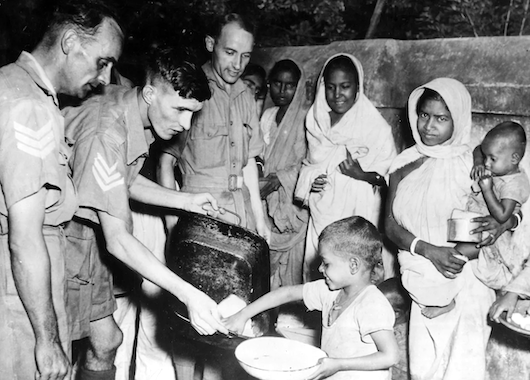
RAF personnel hand out food to children during the Bengal famine in India in December 1943
Perhaps most disturbing is the role of the National Portrait Gallery, a public institution:
A spokesperson for the gallery said it respected Cammock’s decision to withdraw the work, “just as we acknowledge the opinions of those who were offended by what was said in the film”.
“The aim of this project was to give artists the opportunity to create works as personal and creative responses to our collection. The work was presented as an artistic piece, not a documentary, and the views expressed in the film do not necessarily reflect those of the NPG,” the spokesperson said.
Not a documentary, and therefore the “artist” was free to make up vile slanders? And those who were “offended” merely had different “opinions”? And the views expressed in the film (i.e., that Churchill was a mass murderer) “do not necessarily reflect those of the NPG”?
I should hope not. But it is a sign of the degradation of modern institutions that historical fact is merely a matter of opinion, and if you are on the left, you are encouraged to express, in an important public forum, the most absurd calumnies against those who are seen as being on the right.
