As someone who grew up in LA when the Lakers reached their first pinnacle with the great Jerry West/Wilt Chamberlain team that won a record 33 games in a row in the 1971-72 season (by an average margin of 17 points a game), and then to be around for the rise of the “Showtime” Lakers with the arrival of Magic Johnson in 1980, I have been looking forward to the HBO serial dramatization, “Winning Time.” When sports and Hollywood meet, the result is not always salutary. Such is the case with “Winning Time,” though it is thoroughly watchable and has some great moments to balance out its bad ones.
That 1971-72 Lakers team is notable for being led by 33-year old Jerry West, not far from the end of his career, while Wilt was 35, and no longer the scoring powerhouse he had been a decade before. Coach Bill Sharman convinced Wilt to concentrate more on defense and rebounding, and the addition of sharp-shooting Gail Goodrich in the backcourt alongside West diversified the team’s scoring capacity, especially since Elgin Baylor was forced into retirement at the beginning of the season on account of recurring injuries.
 As an aside, I got to shake hands with Wilt once, though “shaking hands” is a bit of a misnomer; my not-especially-small hand disappeared inside his enormous paw. I was dating at the time a Nike-sponsored all-American, Olympic caliber distance runner (except the U.S. didn’t send a team to the 1980 Summer Olympics in Moscow), and she got me into a fancy athletic event in Beverly Hills, where Wilt was the nominal host. Fish out of water, you say? Au contraire: I refer you to Exhibit #1 (left), featuring your sometimes sportswriter navigating the 3,000 meter steeplechase once upon a time in a galaxy far far away, when I also had longish hair. (I’ll add that while I could never dunk a basketball, I did dunk a couple times in the steeplechase—which is not a scoring move, needless to say.)
Around the time this pic was taken in the late spring of 1977, the Lakers came to Portland for their conference championship series with the Bill Walton-led Trailblazers. The Lakers borrowed our gym to hold practice, and someone—I forget whether it was our basketball coach or someone else in the athletic hierarchy—got the Lakers to give permission for a handful of us from various spring sports at the college to sit quietly in the gym and watch the Lakers warm up and run some drills. You got to appreciate how freakishly tall Kareem Abdul-Jabbar is and how his movements were deceivingly graceful, but the real thrill was seeing Jerry West in the flesh. He was the Lakers coach that year, and the Lakers were swept badly in four straight by the Trailblazers, en route to their one magical championship over the 76ers in the finals. Walton was brilliant in that series, but it still seems incredible that a team that matched up Bobby Gross with Julius “Dr. J” Erving could possibly win in such convincing fashion, let alone with a conspicuously short sixth man from Old Dominion with the unlikely name of Dave Twardzik.
There are a number of call-backs to both the 71-72 Lakers, and in a small way to the 1977 Blazers, in the early episodes of “Winning Time.” It was widely reported contemporaneously that Jerry West didn’t like being a floor coach, and before long he moved upstairs to a management role alongside GM (and his former floor coach) Bill Sharman. But was Jerry West really the sullen, temperamental jerk he is portrayed in “Winning Time”? That’s been the major controversy over “Winning Time,” as West, played brilliantly by Jason Clarke, comes off as a hot-headed, drunken a–hole.
I have no idea whether there is any basis to this, but I doubt it. And there has been some talk that the portrait of West is so overdrawn that West might have sufficient cause for legal action against the filmmakers, even before the Heard-Depp verdict suggested a revival of defamation claims. (West has written to the show’s producers demanding an apology, with a hint of a possible lawsuit to follow.) A more interesting question is whether it is true that West opposed drafting Magic Johnson as he thought the team already had one of the best point guards in the league in Norm Nixon.
Likewise one expects a considerable amount of dramatic license in portraying the Lakers story (did Kareem and Magic really come to blows in the locker room?), but the filmmakers also played fast and loose with the facts, or exaggerate their characterizations in ways that detract from the film. I have no doubt that legendary Lakers broadcaster Chick Hearn was an egomaniac; I think it was his sometime color man Keith Erickson who quipped that Hearn had “a low threshold of interruptability.” Paul Westhead and Pat Riley are played for insecure, simpering placeholders in over their heads after they replaced new coach Jack McKinney following McKinney’s serious bicycle accident, while McKinney, who is portrayed as the real genius behind the 1977 Trailblazer’s championship as assistant coach to Jack Ramsey, is played as a badass.
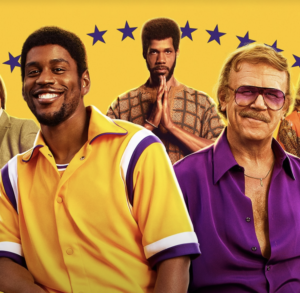 On the plus side of the ledger, the casting and staging of the series is superb, especially John C. Reilly playing the new and badly over-extended team owner Jerry Buss. Reilly was made for this role as much as Jack Black fit School of Rock (a role that was actually written with Jack Black in mind). The rest of the cast is also remarkable for their resemblance to the Laker stars, not only Quincy Isaiah as Magic and Solomon Hughes as Kareem, but down to the supporting Laker stars such as Jamil Atkins as Jamaal Wilkes, and Delante Desouza as Michael Cooper. The person playing Norm Nixon had an especially strong physical resemblance to the real person, and it turns out that the actor DeVaughn Nixon is indeed Norm Nixon’s son. The staged recreations of basketball game scenes are strikingly good. This is often the weakest point of sports films. And one of the very best scenes in in the series depicts Kareem instructing Magic about the skyhook. (See the scene below.)
“Winning Time” has been greenlit for a second season, and I’ll be interested to see how they handle Magic Johnson demanding a trade at the beginning of the 1982 season because he didn’t like coach Westhead’s complex offensive scheme. Westhead was, if I recall correctly, removed as head coach within 24 hours with Jerry West stepping in to replace him as coach temporarily, prompting one of the greatest headlines of all time in the sports section of the Los Angeles Times: “Westhead’s Out; West Heads In—It’s Magic!”
The New York Post headline writers surely looked on with envy that day.
https://www.youtube.com/watch?v=U_ieV5xG7Og
