Middle East
August 9, 2020 — Scott Johnson

The best analysis I have found so far on the August 4 explosions in the port of Beirut is set forth in David Wurmser’s August 7 column “Lebanon: What happened?” Also useful is this backgrounder disseminated by the Shurat HaDin/Israel Law Center. I thought readers might find it of interest. With Shurat HaDin’s kind permission, I am posting it below: As the Lebanese people struggle to recover from the catastrophic
»
August 5, 2020 — Scott Johnson
If you’re wondering about the explosion that rocked Beirut yesterday, you may want to check out the Times of Israel staff report “Mystery swirls around what caused ammonium nitrate to explode in Beirut.” The Times of Israel report is the best I have seen so far. The Times of Israel site has more in the Gambrell/Federman AP story “Expert says ‘cheap pyrotechnics’ likely lit up ammonium nitrate in Beirut.” The
»
January 4, 2020 — Paul Mirengoff
Thomas Friedman calls the late Gen. Soleimani “Iran’s most overrated warrior.” He also calls Soleimani “possibly the dumbest man in Iran.” Friedman explains: In 2015, the United States and the major European powers agreed to lift virtually all their sanctions on Iran, many dating back to 1979, in return for Iran halting its nuclear weapons program for a mere 15 years, but still maintaining the right to have a peaceful
»
September 20, 2019 — Paul Mirengoff
It has become a standard talking point among leftists and Democrats to blame President Trump for Iran’s attack on Saudi Arabian oil facilities. This Washington Post column by David Ignatius provides a good example of the genre. In his opening sentence, Igantius claims that Trump “start[ed] the fight” with Iran. We shouldn’t be surprised by this line of argument. As Jeane Kirkpatrick observed decades ago, the left always blames America
»
September 16, 2019 — Steven Hayward
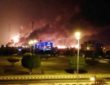
Assuming Iran is indeed behind the attack on Saudi Arabia’s major oil refining facility, it represents a step-increase in Iranian-backed aggression in the region. The Wall Street Journal‘s Spencer Jakab says this attack is “the big one“: Saturday’s attack on a critical Saudi oil facility will almost certainly rock the world energy market in the short term, but it also carries disturbing long-term implications. Ever since the dual 1970s oil
»
August 30, 2019 — Paul Mirengoff
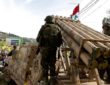
Hezbollah has stated that it intends to produce missiles capable of striking Israel with pinpoint accuracy. Iran is assisting Hezbollah in this enterprise. It is helping Hezbollah construct and develop facilities at which precision missiles are manufactured. Israel has responded by attacking targets in Syria, Lebanon, and Iraq. Attacks in the latter two countries are a recent development, prompted by stepped up Iranian efforts to assist Hezbollah’s missile development. The
»
June 19, 2019 — Paul Mirengoff

Yesterday, I discussed a column by Bret Stephens about how the U.S. should respond if Iran continues to attack ships in the Persian Gulf. Stephens recalled that in 1988, after a U.S. frigate was badly damaged when it hit an Iranian naval mine, we destroyed half the Iranian fleet in a matter of hours. I noted that today Iran is much more capable than in 1988 of inflicting damage on
»
February 22, 2019 — Scott Johnson

In the current Mosaic podcast (introduced here), the Hudson Institute’s Michael Doran supports the withdrawal of American troops from their stations in Syria. In his January essay for Mosaic, Doran defended the White House’s strategy in Syria based on a prudent assessment of geopolitical realities. Weighing the pros and cons, Doran forcefully makes the case that, if the United States is to succeed in advancing its interests and elevating its
»
January 10, 2019 — Paul Mirengoff

Secretary of State Mike Pompeo is in the Middle East trying to assure friends, allies, and non-adversaries that the U.S. isn’t walking away from the region. He claimed that progress has been made in addressing Turkey’s objections to Kurdish militants in northeastern Syria and that Turkey has provided “commitments” that Kurds who fought with U.S. forces against ISIS will be protected when the U.S. leaves Syria. The only public commitment
»
December 14, 2018 — Paul Mirengoff
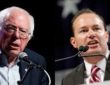
Sen. Mike Lee used to be something of a conservative hero. More recently, he’s become heavy into working with Democrats. Not just any Democrats, but some of the most liberal, most stridently partisan Senate Dems. He and Sen. Dick Durbin combined to sponsor the jailbreak legislation that may well be on the verge of passing the Senate. A few years ago Lee and Durbin collaborated on a jailbreak bill that
»
December 6, 2018 — Paul Mirengoff
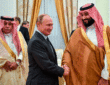
The Washington Post takes time out from urging that the U.S. blow up relations with Saudi Arabia, as retribution for the killing of Jamal Khashoggi, to provide a clear-eyed assessment of reality in the Middle East. The Post’s Liz Sly finds that Russia has become the region’s rising power. Russia has made huge inroads, commercial and diplomatic, throughout the Middle East. The nations that now woo Putin run the gamut
»
November 20, 2018 — Paul Mirengoff

President Trump today announced that, notwithstanding the murder of Jamal Khashoggi, “the United States intends to remain a steadfast partner of Saudi Arabia to ensure the interests of our country, Israel and all other partners in the region.” The essence of Trump’s explanation for the decision is contained in the first sentence: “The world is a dangerous place!” Elaborating on this obvious but oft-neglected truth, Trump cited our interest in
»
October 22, 2018 — Paul Mirengoff

On Sunday, the Washington Post (paper edition) published a lengthy tribute to Jamal Khashoggi, its former columnist. The article is worth reading. Joby Warrick, Loveday Morris, and Souad Mekhennet present a more nuanced and informative account of Khashoggi than the Post has been willing to render until now. I think the Post has recognized that its portrait of Khashoggi as a pro-democracy saint needs to be modified slightly now that
»
October 20, 2018 — Scott Johnson

The Kingdom of Saudi Arabia is apparently unschooled in the arts of scandal management. Having now conceded for the first time that Jamal Khashoggi died in the kingdom’s consulate in Istanbul earlier this month, the kingdom claims that claiming that Khashoggi’s death came after an argument and a “fistfight” with men in the facility. According to Politico’s story, the kingdom has arrested 18 Saudi nationals suspected of involvement in Khashoggi’s
»
October 19, 2018 — Paul Mirengoff
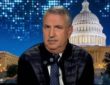
To figure how not to think about events in the Middle East, it’s often useful to consult Tom Friedman. Yesterday, Friedman appeared on PBS with Christiane Amanpour to discuss the murder of Jamal Khashoggi. Friedman looks like a fool in the wake of the murder because last year he wrote a gushing column praising Mohammed bin Salman (MBS), Saudi Arabia’s powerful crown prince, for implementing a “top-down Arab spring.” Friedman
»
October 19, 2018 — Paul Mirengoff
The Washington Post decries what it calls a “whispering campaign” to “smear” Jamal Khashoggi that is “designed to protect President Trump”. The “whisperers” are “hard-line Republicans and conservative commentators.” The latter are writing articles critical of Khashoggi (which means they are not whispering). The former are “privately sharing” the articles (which, I had thought, is how articles typically are shared). The Post’s Robert Costa and Karoun Demirjian provide no evidence
»
October 18, 2018 — Paul Mirengoff

Many questions surround the apparent murder of Jamal Khashoggi. By far, the most important ones are who, exactly, is responsible and what will the U.S. do in response. Here’s another question that, although of far less importance, may be of interest: Why did the Washington Post hire Khashoggi as a contributor? David Goldman describes Khashoggi as “a top level spook who played a high-stakes game in Saudi spookdom.” Is Goldman
»
