Through pretty much all of human history, if you wanted to survive you had to work. Of course, there have always been people who were truly disabled and needed to be cared for by others, but their numbers were small. In recent years, that has changed. Now, there is a virtual army of people who to all appearances are able-bodied, but who for some reason have successfully claimed to be totally disabled. Failed Maine Senate candidate Graham Platner is a good instance of this phenomenon.
The numbers of the allegedly disabled are skyrocketing. The Unleash Prosperity Hotline displays the trend graphically:
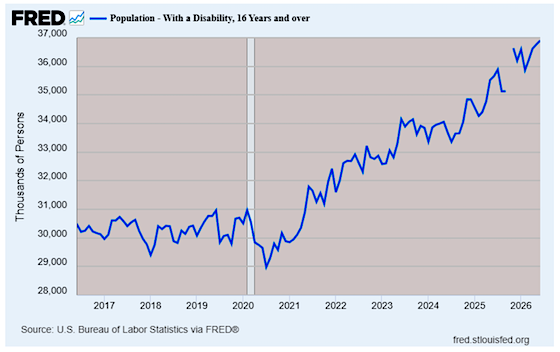
Looking at the chart, one is tempted to say that covid marked a weird and entirely negative turning point in American life. I would offer a different interpretation: the Biden administration marked a weird and entirely negative turning point in American life. Why did millions of Americans, including a great many young men, suddenly decide that they were “disabled”? Because there was money in it. The Biden administration unleashed a torrent of trillions of dollars in unearned income, which just about anyone could qualify for by, among other things, being “disabled.”
The Hotline writes:
How is it conceivably possible that at a time when workplace injuries are lower than ever before, and an ever-smaller share of Americans are involved in hard labor – factory jobs, construction, mining and ag – that more Americans than ever are claiming they are disabled?
Follow the money. The rate of alleged disability has continued to climb after 2024, but the Biden administration is obviously the time when the disability strategy gained respectability and took off. I don’t know that anything has been done to dampen the trend since.
Quite a few year ago, I wrote on Power Line about rates of disability in two virtually identical Scandinavian countries: Norway and Denmark, say. For some reason, the number of people claiming to be totally disabled was vastly higher in one country than the other. Was it really possible that many more Danes, say, were disabled, per capita, than Norwegians? Of course not. The difference lay not in the physical condition of the countries’ populations, but in their laws: disability benefits were much easier to obtain, and more generous, in one country than the other. So of course many more people sought to be disabled. It was all about incentives.
The social cost of having millions of able-bodied people, especially young men, idle and claiming to be disabled goes far beyond the cost of government welfare programs. We would be much better off if such programs, at both the federal and state levels, were cut back substantially.
