As John discusses below, yesterday’s election in the UK is what is known as a “stonking” by the Labour Party, which gained its largest majority in decades. However, by raw vote totals, it is clear that the election result is hardly a mandate for Labour’s very left agenda that I predict will be very unpopular in a matter of months, and this will show up in the first by-elections that will be held.
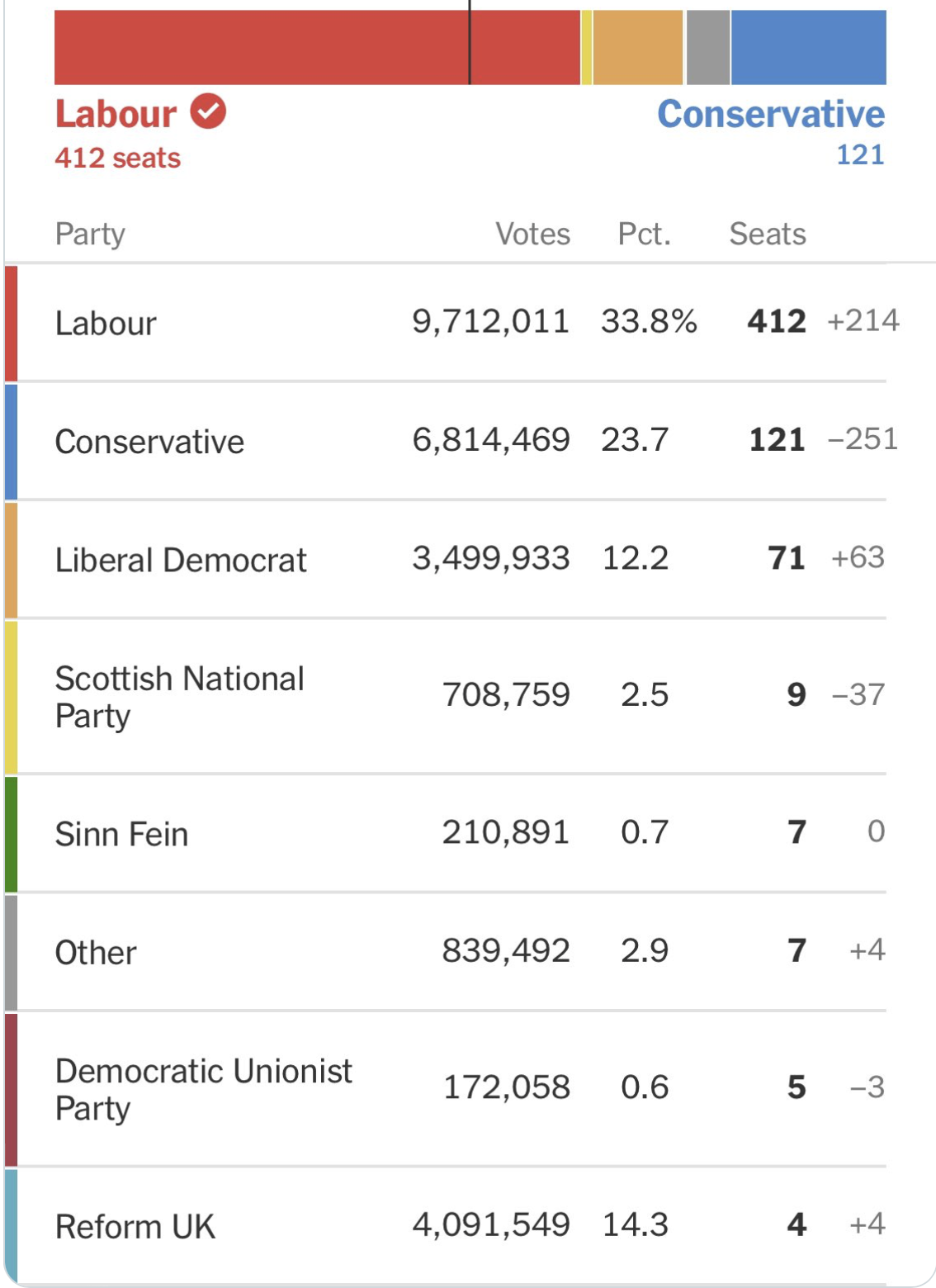
As you can see from the chart below of the final election results, Labour only received 33.8 percent of the total vote (and as it was a low-turnout election, Labour received fewer total votes and a lower percentage of the vote than under Jeremy Corbyn in 2019), while the Conservative Party and the new Reform Party received a combined total of 38 percent of the vote. It is quite amazing that a party could get fewer votes than it did in a total rout four years ago, and yet score a “landslide” in parliamentary seats won.
In a continental-style proportional representation scheme, it might well be a coalition of the Tories and the Reformers who formed a government, and not Labour. To be sure, the LibDems would holds the balance of power, but let’s recall the LibDems went into coalition with the Tories back in 2010, so who knows. But in Britain’s first-past-the-post system, Labour is the disproportionate winner. Does it make any sense that the Reform Party got more votes than the LibDems, but only four seats, while the LibDems got 71 seats? (And yet people say our electoral college and Senate are “undemocratic.”)
I’m not a fan of ranked-choice voting schemes, but one can imagine a highly different outcome if Britain had a ranked-choice system for this election.
However you figure it, this election stonks to high heaven. But the Tories deserved it.
