Price fixing is a terrible idea, pretty much always and everywhere. That goes for fixing the price of labor as much as anything else. This old lesson is now being re-learned in Britain: Rishi Sunak: What I got wrong on the minimum wage. What the former Prime Minister got wrong is, he was in favor of it:
As Labour prepares for this leadership debate, it should heed figures out this week: unemployment is now 5 per cent and only half of under-25s are in paid employment. Every contender should have a coherent answer to how we can reverse these trends and avoid creating a lost generation of young people.
Only half of those under 25 are employed? That is appalling. Britain’s high minimum wage is a big part of the reason, along with high welfare benefits the carry no work requirement:
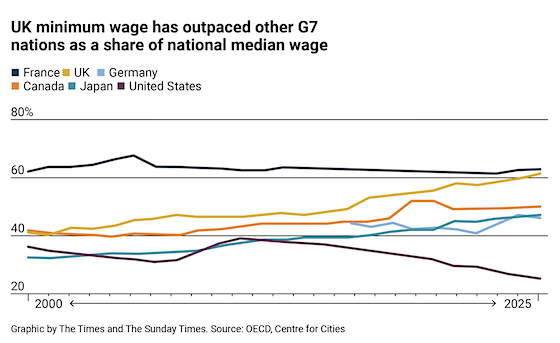
What ministers have yet to grasp is that the minimum wage is too high. What began as a measured and successful effort to tackle low pay is now causing unemployment. We have the highest minimum wage in the G7 in absolute terms, only just below France as a share of earnings. The national living wage is up by almost a third in real terms over the past decade, while productivity has only increased by 6 per cent.
A minimum wage does little harm, as long as it is set below what is actually being paid in the marketplace to entry-level workers. If you set it above the market level, you will raise unemployment.
I worry that a Labour leadership contest will exacerbate these problems. Angela Rayner has demanded Labour go further on employment rights and abolish the youth discount on the living wage entirely. After the local elections, she declared “a rising minimum wage must go alongside our programme to get young people into work”, without acknowledging the tension between the two.
If the current Labour government remains in power, it will only make matters worse. The following confession is interesting:
Now, I should admit I did not stop this ratchet. When I was chancellor, I asked the country’s business groups whether they would be willing to urge the Low Pay Commission (LPC) to freeze the level of these wages. They quickly made it clear they weren’t prepared to get publicly involved in this debate.
I decided that for a multimillionaire chancellor to overrule the LPC without any covering fire wasn’t politically sensible — and so let that pay carry on rising. I now wish I’d been braver and acted anyway.
Courage to stand up for correct economic principles is in short supply in most countries, including ours. But this chart is interesting. It suggests that the minimum wage in the U.S. does less harm than in most other developed countries:
The minimum wage issue is not hard to understand. If you require that a given worker be paid more than the value of his economic contribution to an enterprise, you render him unemployable. It is a terrible thing to do, and young people struggling to enter the labor force suffer the most. Not too many years ago, both the New York Times and the Washington Post editorialized, correctly, that the appropriate level for the minimum wage is zero. (Actually, regardless of what politicians say, there is only one minimum wage, and it never changes. It is zero, which apparently is what half of those in Britain under the age of 25 are earning.) I doubt that there is a single politician in the Democratic Party who would be brave enough to say that today.
