that our attack tonight has been called off. That was President Trump’s big news about our conflict with Iran yesterday. The attack had been advertised by Trump to take place last night. Trump’s announcement put me in mind of the title of Philip Gourevitch’s award-winning book about the slaughter of the Tutsis in Rwanda — We wish to inform you that tomorrow we will be killed with our families (1998). This was Trump’s announcement.
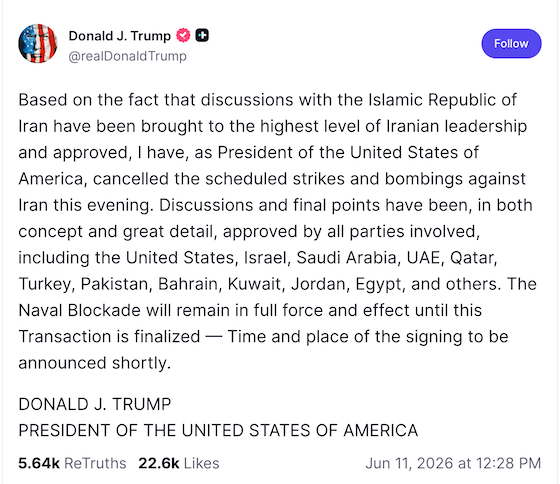
Trump called it a “great settlement.” He did not declare “peace for our time” or wave around the memorandum of understanding that is to be signed by representatives of the parties in Europe some time soon. The terms of the “settlement” are to be set forth in the memorandum of understanding.
President Trump to the contrary notwithstanding, Iranian spokesmen assert we’re in a Jack Benny situation — they’re thinking. “So far, Iran has not reached a final conclusion on the agreement,” foreign ministry spokesman Esmaeil Baqaei said in a statement provided to Agence France-Presse. (I am drawing on reports compiled by CBS News here in its live updates.)
AFP cites Iran’s semi-official Fars News Agency, “which is associated with the Islamic Revolutionary Guard Corps,” and quotes a “knowledgeable source close to the Iranian negotiating team” who denied the president’s claim about an agreement on an initial deal and stated that “no text of the initial memorandum of understanding with the United States has been approved.”
CBS News adds that — according to Iran’s Tasnim news agency — the president has announced a deal was imminent 38 times in the previous two months. “Until Iran announces the matter of a potential understanding, any news from Trump on this subject should be regarded the same as his previous messaging.”
At an Oval Office event yesterday, Trump put it this way: “The documents are in pretty final shape.” Further, the Strait of Hormuz “will officially open as soon as we sign, which could be soon, very soon.”
I take Trump at his word. According to his own formulation, however, the “Transaction” has yet to be “finalized.” Our blockade remains in effect. Given the apparent familiarity of this scenario, the Iranian razzing should at least be noted.
This too is familiar. Overnight — CBS News reported at 3:11 a.m. (Eastern), just before I began writing this summary — “A U.S. official said it appears Iran has attempted to strike commercial ships transiting the Strait of Hormuz early Friday morning local time. U.S. forces have shot down two Iranian one-way attack drones, the official said.” We regret to inform you that Iran did not call off its attack on the ships.
The signing of the memorandum of understanding, whenever it occurs, is to extend the problematic “ceasefire” that has yet to cease the fire for another 60 days. Under the terms of the memorandum of understanding, according to Axios, a mechanism is to be established for the release of Iran’s frozen assets. The Strait of Hormuz is to be opened during the 60-day ceasefire period. Negotiations over Iran’s nuclear program would be conducted during the 60-day ceasefire period. Insert groans here.
Axios reporter Barak Ravid has more here. He adds that the terms of the 60-day ceasefire include “Lebanon” — i.e., Israel — although Prime Minister Netanyahu has emphasized that Israel is not a party to the agreement.
Ravid reports that “[t]he text includes a framework for addressing Iran’s enriched uranium stockpile, though any action on Iran’s nuclear program would depend on a second, more detailed accord.” Further, Iran is “to receive sanctions relief based on compliance, according to a diplomat from one of the mediating countries and a U.S. official.”
Maybe, as Mark Twain almost said of Wagner’s music, it’s much better than it sounds.
