By this time, pretty much everyone knows that Minnesota has become a high-crime state on Tim Walz’s watch. That is due in large part to his freezing up for four days during the George Floyd riots, and to his generally anti-law enforcement attitudes.
But there is more to it than that. Tim Walz and Attorney General Keith Ellison took office in January 2019. They immediately embarked on a pro-crime, anti-law enforcement agenda that has dramatically reduced the rate of incarceration in Minnesota. Not surprisingly, the rate of violent crime has correspondingly increased. American Experiment’s Policy Fellow David Zimmer has the story. This chart is what you need to know:
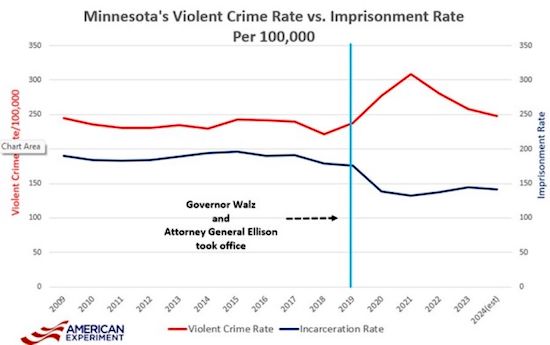
But why did the incarceration rate decline under DFL leadership? David Zimmer explains:
After three years of deteriorating public safety following the “uprising” of 2020, it would have made sense for Minnesota’s political leadership to take action to address violence through the creation of more swift and certain consequences for violent offenders. Instead, the “trifecta” of a progressive led House, Senate, and Governor passed into law multiple “reform” minded public safety measures which placed more emphasis on the effect the laws would have on criminals than the effect the criminals’ actions would have on innocent victims.
Some of these reform minded initiatives included:
* The creation of the Office of Restorative Practices, the Clemency Review Commission, and the Attorney General’s Office’s Conviction Review Unit
* Automatic expungements of criminal convictions
* Felony murder resentencing
* Prosecutor initiated sentencing review
* Supervision (probation) abatement
* Prison related early release incentive program
Sure enough, if you implement enough liberal, pro-crime policies, guess what? Crime goes up. How many Minnesotans have been hurt by Tim Walz’s pro-crime ideology? I don’t know. Thousands.
I should note that this data set is “violent crime,” which is slightly different from some other charts David has prepared that track “Part 1 crimes,” i.e. the most serious crimes as defined by the FBI. That data set includes some non-violent crimes like arson.
