As I wrote earlier this morning, I knew it was almost noon in Israel and Amit Segal would be filng his daily dispatch presently. It has now arrived. I see it does not contrast with my own observations, but his are harsher. I thought some readers might appreciate his perspective from Israel. This is a long excerpt of the column he headlines “Israel vs. Iran: Round 3”:
* * * * *
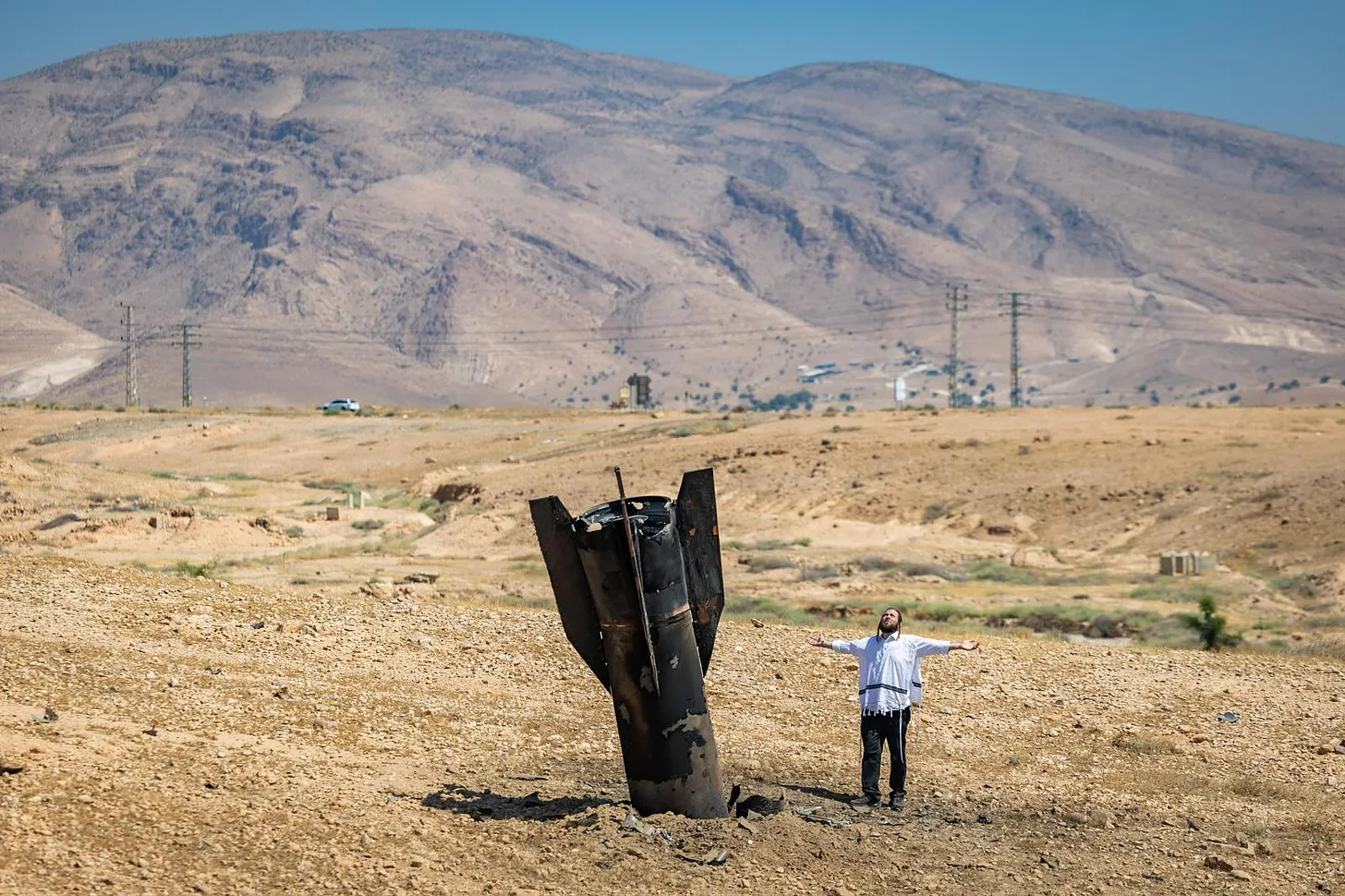
A man stands next to an Iranian missile from last night’s attack. (Chaim Goldberg/Flash90)
It’s Monday, June 8, and the masquerade is over. After last night’s direct Iranian strikes on Israel, the fundamental question driving the last two months of “ceasefire” has been shoved into the open: who controls the post-Epic Fury status quo—Iran or the United States? For now, the answer is Iran.
Let’s run through the recent events:
• Sunday (~9:00 AM IDT): Hezbollah fires a barrage of rockets toward northern Israel, brazenly violating the ceasefire.
• Sunday (~3:15 PM IDT): Israel responds to the cross-border fire by conducting a targeted airstrike against a Hezbollah headquarters in the southern suburbs of Beirut.
• Sunday (~10:00 PM IDT): Iran launches two waves of ballistic missiles targeting the Ramat David Air Base in northern Israel, declaring the strike direct retaliation for the Beirut bombing.
• Overnight: Trump speaks to the media asserting dominance over the situation. He tells the Financial Times that Netanyahu “doesn’t call the shots,” tells Axios “We don’t need another one,” and insists to NBC that his pending peace deal is still viable.
• Monday (~6:00 AM IDT): Air defense sirens wail across central Israel following a missile launch from the Houthis in Yemen. The projectile is successfully intercepted with no casualties reported.
• Monday (~7:00 AM IDT): it is officially announced that Israel launched a wave of retaliatory airstrikes on military targets and petrochemical facilities in central and western Iran, explicitly ignoring Trump’s pressure to stand down.
• Monday (~7:20 AM IDT): Loud explosions echo over Jerusalem as the IDF confirms it is actively intercepting a fresh wave of missiles launched from Iranian territory.
What made Tehran bold enough to strike directly?
The answer is Trump. Tehran may not field a first-class air force or navy, but they possess the absolute best detection equipment in the world for one specific signal: a lack of willingness to fight. For years, Hamas and Hezbollah detected this exact hesitation in Israel and exploited it to gain ground. Today, Iran is doing the exact same thing to the United States. It comes down to the old idiom: give them an inch, and they’ll start firing at a mile of your sovereign territory.
Two months of projected American weakness and a blind obsession with securing a deal have brought us straight to this moment. The collapse started when Washington chose to look the other way during Iranian missile and drone launches in the Gulf. It accelerated every time the U.S. conceded ground just to keep Tehran from abandoning the talks, culminating in the immense pressure to hold Israel back from striking Beirut and the forcing of a hasty, fragile “ceasefire” in southern Lebanon. Tehran smells the desperation and knows exactly what the U.S. is terrified of losing. As an advisor to Supreme Leader Mojtaba Khamenei phrased it: “In the bombing in Beirut, the enemy set the negotiating table on fire for the third time.”
So far, it seems Iran guessed correctly. Overnight, Trump went on Fox News with a message for Tehran: “You’ve shot your missiles, that’s enough, get back to the table and make a deal.” In so many words, Trump is simply repackaging Joe Biden’s infamous April 2024 warning to Iran: “Don’t.” Judging by the multiple, separate ballistic barrages launched from Iranian territory this morning, it promises to be just as effective.
The situation is deeply reminiscent of the 1991 Gulf War, when President George H.W. Bush demanded that Israel refrain from responding to Saddam Hussein’s Scud attacks, pointing to the grander American campaign to handle the Iraqi threat. Israel ultimately capitulated, leading Prime Minister Yitzhak Shamir to famously admit that Jerusalem “had no alternative other than to work within the framework proposed by the Bush Administration”—a compliance that severely dented his security credentials and cost him the next election.
Today, Donald Trump is selling a similar illusion, claiming his diplomatic maneuvers will soon nullify the Iranian threat and Israel will just have to bare the rocky road to peace. But the 2026 reality diverges in one fatal way: it simply isn’t true. There is no “Great Scud Hunt” to blunt the threat, and no military campaign against the offending country appears imminent. If anything, it has never looked further away.
Rather than 1991, Israel seems to be back in 2024, facing an emboldened Axis of Resistance alone. But in 2026, Israel is handcuffed by an additional constraint: Washington’s hunger for a deal. Tied to U.S. diplomatic goals, Israel’s retaliatory strikes have been hollowed out. Yesterday, they hit evacuated headquarters in Dahiyeh; this morning, they hit secondary petrochemical sites in Mahshahr, deliberately leaving Iran’s critical energy infrastructure untouched. Israel is using a light touch because they are more scared of Trump’s reaction than Iran is.
But the collapse of deterrence is not just an Israeli problem. Iran is sprinting up the escalation ladder. If Tehran learns it can strike Israel with impunity, the next time they feel like throwing a tantrum, Gulf energy facilities will be in their crosshairs, followed closely by American military bases….
See the whole thing here. Segal credits the thumbnail image on the home page and the photo at the top to Chaim Goldberg/Flash90 with the caption I have borrowed: “A man stands next to an Iranian missile from last night’s attack.”
