Spencer Pratt: I’m Not Going Away

Spencer Pratt released a fiery new video today. He says he will continue his campaign to expose the corruption that has driven Los Angeles into the ground. And he says he has evidence against one of the two socialists who will participate in the runoff election, that may force that person to resign.

Buckle your seat belts:

For what it’s worth

“Paranoia strikes deep,” goes the classic Buffalo Springfield song. How about the hatred of Jews? It doesn’t have quite the same ring, but a federal indictment emanating from a cast of characters associated with the University of Michigan provides a glaring example of how deeply it strikes.

The indictment handed up by a grand jury in the Eastern District of Michigan runs to 63 pages and variously alleges ten counts against eight defendants. It is posted online here by the New York Times. The illustrated Department of Justice press release is posted here.

The eight defendants are pro-Hamas fruitcakes of a familiar variety. The variety is familiar because it emerged like Kudzu in the aftermath of 10/7.

FBI Director Kash Patel summarized the indictment on X:

The indictment alleges that after the October 7, 2023 Hamas terrorist attack on Israel, these individuals – a group of college-aged adults – engaged in a coordinated campaign of violent, criminal acts seeking to pressure University of Michigan leaders and other businesses in the Eastern District of Michigan to cut off all ties with Israel.

The subjects allegedly vandalized the victims’ property, spray painted their homes with messages like “Intifada” and “Free Palestine,” left threatening notes on their doors, and even broke windows of the victims’ homes – throwing glass jars filled with chemicals while children slept inside.

They deliberately chose the one-year anniversary of Hamas’s attack to engage in some of their most visible criminal acts – including one subject who specifically targeted the Bloomfield Township Jewish Federation on October 7, 2024. On the same day, another subject – employed by the University – vandalized the University President’s home.

The alleged criminal targeting occurred for over a year – beginning approximately March 2024 and continuing until April 2025.

Adam Kredo has the Washington Free Beacon’s straight news account here.

Seth Mandel comments on the indictment in this Commentary post. Thinking about Kudzu, I offer you an excerpt:

As it happens, one of the defendants accused of participating in this group’s alleged campaign of terrorizing families is Mariam Odeh. According to the Detroit News, Odeh worked as recently as April for the Senate campaign of Democratic candidate Abdul El-Sayed. The campaign confirmed the report. This work came after the events described in the complaint. So perhaps these folks have a future after all—so long as they want to work in Democratic Party politics.

Another connection in the thread: In April 2024, pro-Hamas activists set up an encampment on a main open area on Michigan’s campus. A fire marshal was called in to assess, and he found that “the densely placed tents with no egress pathways and the highly combustible nature of the tent materials and other furnishings have made this encampment highly susceptible for a fire to occur and inescapable for any occupants to flee in the event of a fire. If a fire were to occur within this encampment, the human casualty rate would be catastrophic.”

Those at the encampment refused to pack up their generator and multiple electronic devices and tents and chickenwire and everything else that made it a hazard, so the school had law enforcement clear it out. Those resisting the police were charged. A man named Amir Makled was the defense lawyer for some of them. Eventually, Michigan Attorney General Dana Nessel was pressured to drop the charges because Democrats complained loudly that her Jewish faith prevented her from fairly prosecuting the case. When Nessel gave in to this chilling anti-Semitic pressure campaign, Makled rejoiced.

In April, Makled was chosen by the state Democratic Party to replace one of the University of Michigan regents, Jordan Acker. As it happens, Acker is Jewish and was one of the targets of the harassment and intimidation campaign for which Odeh and her associates stand accused. Makled has also appeared at Sayed’s campaign rallies.

That is where we are in progressive politics of 2026. And it is the state of higher education in various places around the United States. And, yes, it is a sign of a very broken academic and political culture.

The Jewish Federation of Detroit, which was also vandalized by the group, issued this statement applauding federal, state and local law enforcement for taking action:

The Jewish Federation of Detroit applauds the U.S. Attorney’s Office for the Eastern District of Michigan, the FBI, and state and local law enforcement for the investigation leading to the indictment and arrest of eight defendants alleged to have conspired to threaten and intimidate Jewish leaders, businesses, and community institutions, as well as law enforcement in our community.

The indictment details a deliberate campaign of intimidation and terror: attacks on private homes, threats to “get” the “kids” of victims, witness intimidation, and the targeting of Jewish institutions, including our own. Many of the alleged threats directly reference the Hamas-led terror attack on October 7, 2023.

We are grateful to law enforcement for pursuing this investigation with the seriousness it demands, and we look forward to seeing justice served, sending a clear message that hate, intimidation, and antisemitic violence have no place in our community or in our country.

As for the receipt of the message, I am afraid the statement is overoptimistic.

The case is illustrative. Hatred of Israel is a form of anti-Semitism. “Pro-Palestinian” is frequently a euphemism for “pro-Hamas.” The Washington Post, for example, calls the defendants “pro-Palestinian activists.” This is what the keffiyeh is all about. It represents a state of mind that is now embedded in the Democratic Party. One can’t help but wonder how long this can go on.

We regret to inform you…

that our attack tonight has been called off. That was President Trump’s big news about our conflict with Iran yesterday. The attack had been advertised by Trump to take place last night. Trump’s announcement put me in mind of the title of Philip Gourevitch’s award-winning book about the slaughter of the Tutsis in Rwanda — We wish to inform you that tomorrow we will be killed with our families (1998). This was Trump’s announcement.

Trump called it a “great settlement.” He did not declare “peace for our time” or wave around the memorandum of understanding that is to be signed by representatives of the parties in Europe some time soon. The terms of the “settlement” are to be set forth in the memorandum of understanding.

President Trump to the contrary notwithstanding, Iranian spokesmen assert we’re in a Jack Benny situation — they’re thinking. “So far, Iran has not reached a final conclusion on the agreement,” foreign ministry spokesman Esmaeil Baqaei said in a statement provided to Agence France-Presse. (I am drawing on reports compiled by CBS News here in its live updates.)

AFP cites Iran’s semi-official Fars News Agency, “which is associated with the Islamic Revolutionary Guard Corps,” and quotes a “knowledgeable source close to the Iranian negotiating team” who denied the president’s claim about an agreement on an initial deal and stated that “no text of the initial memorandum of understanding with the United States has been approved.”

CBS News adds that — according to Iran’s Tasnim news agency — the president has announced a deal was imminent 38 times in the previous two months. “Until Iran announces the matter of a potential understanding, any news from Trump on this subject should be regarded the same as his previous messaging.”

At an Oval Office event yesterday, Trump put it this way: “The documents are in pretty final shape.” Further, the Strait of Hormuz “will officially open as soon as we sign, which could be soon, very soon.”

I take Trump at his word. According to his own formulation, however, the “Transaction” has yet to be “finalized.” Our blockade remains in effect. Given the apparent familiarity of this scenario, the Iranian razzing should at least be noted.

This too is familiar. Overnight — CBS News reported at 3:11 a.m. (Eastern), just before I began writing this summary — “A U.S. official said it appears Iran has attempted to strike commercial ships transiting the Strait of Hormuz early Friday morning local time. U.S. forces have shot down two Iranian one-way attack drones, the official said.” We regret to inform you that Iran did not call off its attack on the ships.

The signing of the memorandum of understanding, whenever it occurs, is to extend the problematic “ceasefire” that has yet to cease the fire for another 60 days. Under the terms of the memorandum of understanding, according to Axios, a mechanism is to be established for the release of Iran’s frozen assets. The Strait of Hormuz is to be opened during the 60-day ceasefire period. Negotiations over Iran’s nuclear program would be conducted during the 60-day ceasefire period. Insert groans here.

Axios reporter Barak Ravid has more here. He adds that the terms of the 60-day ceasefire include “Lebanon” — i.e., Israel — although Prime Minister Netanyahu has emphasized that Israel is not a party to the agreement.

Ravid reports that “[t]he text includes a framework for addressing Iran’s enriched uranium stockpile, though any action on Iran’s nuclear program would depend on a second, more detailed accord.” Further, Iran is “to receive sanctions relief based on compliance, according to a diplomat from one of the mediating countries and a U.S. official.”

Maybe, as Mark Twain almost said of Wagner’s music, it’s much better than it sounds.

Europeans Prepare to Defend Themselves, Or Don’t

Europeans are facing the prospect that Russia may attack them, and they may have to defend themselves without much help from the United States. At a minimum, they have taken to heart Secretary of War Pete Hegseth’s warning that the U.S. is preoccupied with our peer rival, China, and our own borders, and Europeans must take the lead on defending themselves against Russia, a peer rival for them. As a worst case, Europeans fear the U.S. may actually withdraw from NATO.

I don’t think that will happen, but the Europeans are now more serious about national security than they have been at any time since the height of the Cold War. In Poland, for example: “Poland prepares to stand its ground with massive new civil defence programme.”

Since the start of Russia’s full-scale invasion of Ukraine in 2022, Poland has increased its military spending to 5 percent of its gross domestic product. It has also bought tanks, air defence systems, infantry fighting vehicles, rocket systems, stealth jets and drones to build one of the largest artillery inventories in Europe. It has also set a target of 300,000 troops by 2039, which would make its armed forces the largest in NATO, after the US and Turkey.

There is much more at the link. Poland is preparing its civilian population to support a potential war effort:

The wGotowości, or Readiness, programme was created to prepare Polish society for any number of situations ranging from cyberwar to a full-scale invasion. The initiative is “the largest program of universal, voluntary defence training in Polish history”, the country’s Defence Minister Wladyslaw Kosiniak-Kamysz said when the program was launched in November last year.

The programme stands out among similar initiatives to train European civilians for war because of its massive scale. Kosiniak-Kamysz said he hoped 400,000 people would complete training sessions by the end of 2026. The wide age range – with no upper limit – includes everyone from teenagers to seniors.

Poland’s history helps, no doubt, when its government wants citizens to focus on the need for effective defense against foreign invasion.

Then there is the U.K. Its Labour government under Keir Starmer acknowledges the need to beef up national defense, but its fiscal priorities lie elsewhere–welfare, primarily, and “green” fantasies. Today British politics underwent a seismic shock as Minister of Defence John Healey, a Labour loyalist, resigned:

A year of intense Westminster wrangling over how to pay for Britain’s armed forces to remain relevant in a time of surging global instability spectacularly exploded into the open on Thursday when John Healey announced his resignation from government. In his scorching broadside of a resignation letter to the Prime Minister, Healey noted the government was not only refusing to fund its own Strategic Defence Review (SDR), but that even if it had the document had already been rendered inadequate by new conflicts and Britain’s growing military commitments in the 12 months since it was published.


I don’t want to overstate the case: Britain has raised its defense spending to 2.5% of GDP, while Healey’s principal concern is that it is not slated to rise significantly in the next few years. The U.S., for comparison, spends around 3.3% of our (much larger) GDP on defense.

With hindsight, it is remarkable that Donald Trump was the first major American politician to raise the issue of Europe’s contribution to its own defense. Almost immediately after Trump began saying that the Europeans needed to contribute more, they agreed that he was right. And they did, in fact, to varying degrees, increase their commitments to military security.

They have raised their spending on defense, but how effective their militaries will be in the event of a Russian onslaught is another question. America is powerful not just because we spend a lot of money of defense, but because we have a strong military tradition and a critical mass of young men who are willing to fight. In the end, those elements mean more than entries on a balance sheet.

That said, I don’t think Russia is likely to invade anyone other than Ukraine in the foreseeable future. Hats off to the Ukrainians: thanks to them, the Russians have their hands full, and thanks largely to U.S. production of oil and gas, their economy is in shambles. But to the extent that European countries are willing to revive their military traditions and take primary responsibility for defending themselves, it can only be a good thing.

And who knows? Their concerns about the possibility of a Russian invasion are based on their own intelligence, and may turn out to be well-grounded.
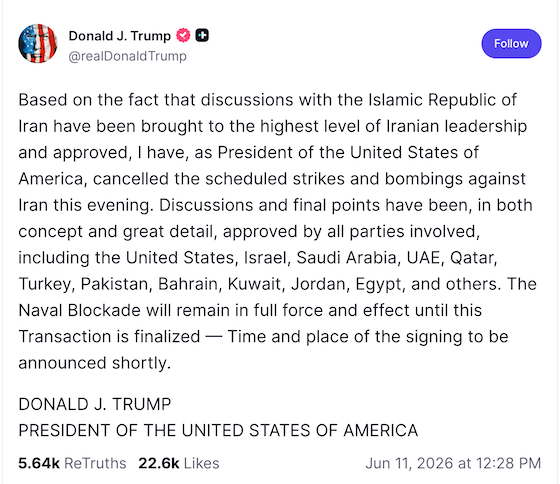

Peace In Iran?

President Trump says an agreement with the IRGC has been reached “in both concept and great detail,” and has suspended further bombing for the time being:

Trump subsequently had a brief call with the New York Post in which he said, “It’s pretty much all wrapped up.” Whether this time is different from the many previous occasions on which the President has said that a deal is very close, remains to be seen.

The financial markets are buying it, though: the Dow surged 1,000 points on the news.

Will Supreme Court Crack Down on Election Autumn?

There are a great many things wrong with our election systems, but one of them may be addressed in a case that awaits decision in the Supreme Court. The case is Watson v. Republican National Committee, and the issue is whether the State of Mississippi’s statute allowing ballots that arrive after Election Day to be counted violates federal law.

Article 1, Section 4 of the Constitution says:

The Times, Places and Manner of holding Elections for Senators and Representatives, shall be prescribed in each State by the Legislature thereof; but the Congress may at any time by Law make or alter such Regulations, except as to the Places of chusing Senators.

The relevant federal laws, which would govern over any inconsistent state law, include 2 U.S.C. Sec. 7:

The Tuesday next after the 1st Monday in November, in every even numbered year, is established as the day for the election, in each of the States and Territories of the United States, of Representatives and Delegates to the Congress commencing on the 3d day of January next thereafter.

And 3 U.S.C. Sec. 1:

The electors of President and Vice President shall be appointed, in each State, on election day, in accordance with the laws of the State enacted prior to election day.

The Republican National Committee says the federal statutes mean what they say: for national elections, we have an Election Day, not an Election Season. At oral argument, most justices seemed sympathetic to that argument.

We have seen in California how counting ballots received well after Election Day gives the appearance, and perhaps the reality, of widespread fraud. The Watson case wouldn’t directly impact what is happening now in California, as those are state, not federal, races. But if the Court enforces the concept of an Election Day, states likely will conform their own procedures rather than try to administer separate federal and state voting and counting protocols.

Getting back to the concept of an Election Day would be a step forward, but would leave a great deal of room for further reforms.

Fujimori inches ahead

As predicted, with the vote count continuing in the Peruvian presidential election, right-wing candidate Keiko Fujimori has retaken the lead from her left-wing opponent, Roberto Sanchez.

With more than 98 percent of the total vote counted, Fujimori leads by fewer than 600 votes, out of more than 18 million cast. Polymarket favors a Fujimori win over 96 percent.