Last Wednesday, a perpetrator was shot and killed by a police officer in Madison, Wisconsin. The man was wrestling with three officers, pulled a knife, and wounded one of the officers before he was shot. The story is illuminating on several levels, and my colleague David Zimmer brings the voice of experience to analyzing what happened:
On Wednesday afternoon, in Madison, Wisconsin, a police officer fatally shot a suspect who was resisting arrest while armed with a fixed-blade knife. The suspect reportedly cut or stabbed an officer while resisting arrest, and that officer fired three shots that killed the suspect.
The officer-involved shooting (OIS) was captured on video by a bystander. The suspect was a black male, and the involved officers included three white males and a white female. The difference in race was immediately raised by activists to suggest, without evidence, that the shooting was racially motivated and unjustified.
The perp was entering parked cars and tried to break into a house. Citizens called the police.
When police arrived in the area, they located the suspect, later identified as Corey Ruiz, 38. Ruiz fled from officers on a bicycle. Officers were able to catch up to Ruiz and attempted to physically restrain him in the street — this is where the available citizen video begins. Madison police do not currently have body-worn cameras, so that perspective will not be available in this case.
The available video, taken from a vantage point approximately 20 feet behind Ruiz, shows three male police officers struggling with Ruiz. One officer had Ruiz’s left arm, one officer was holding Ruiz’s torso from behind, and one officer had Ruiz’s right arm.
You can see the video here. David analyzes the encounter in detail. An attempt to tase Ruiz apparently failed, and one of the officers shot Ruiz, reportedly after Ruiz had cut him with a knife. This is the knife:
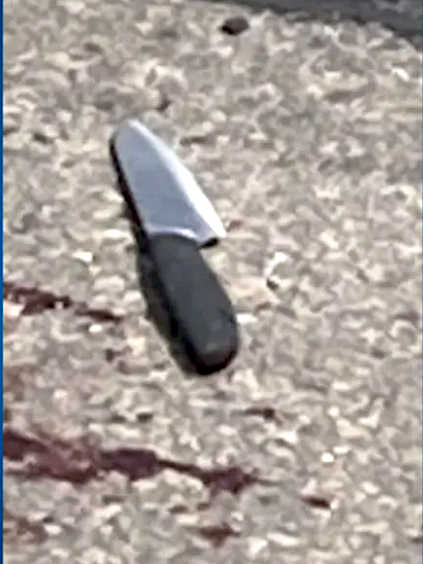
David also relates the appalling response of Madison officials to the incident:
The city of Madison held a press conference yesterday to update the public on events surrounding the OIS. It was a disaster. The conference was taken over by an activist who forced the police chief away from the podium, offering a textbook example of how not to respond.
First, the comments made by the officials who spoke portrayed Ruiz as a promising citizen who had been targeted for assassination by officers. Not a single mention was made of Ruiz’s criminal history. Only the police chief made any mention of Ruiz’s possession of a knife or the danger that he presented to the public and to officers.
Ruiz had 40 criminal convictions, including 12 felonies. More than one of the convictions involved assaulting and/or resisting officers. There was an active warrant out for Ruiz’s arrest.
Then the City Council President, Sabrina Madison, shared her thoughts after watching the video of the shooting.
“I’m telling you, I’m like, my first thought is when the officer is walking away, why isn’t he walking away in cuffs? That’s my first thought.”
Then the Chief of Police, John Patterson, spoke. Chief Patterson unfortunately collapsed in his role as the leader of the police department.
His demeanor was pained and passive. His remarks were peppered with sighs as he slouched and focused down at the podium or the ground. The lack of command presence was simply, sad.
***
Then, just six minutes into his comments, the chief passively allowed an activist to literally force him away from the podium and take over the press conference for 15 minutes — calling Patterson’s officers “pigs” and demanding their immediate arrest.
Unbelievable. The incident, and the authorities’ response, may set Madison on the road to becoming another Minneapolis. But David also makes an important point about the officers:
I hate to be critical of the officers, but they failed to use the proper level of aggression needed to quickly secure Ruiz. In simple terms, they needed to “turn it on” and they didn’t — probably because they’ve been threatened with discipline for use-of-force situations that result in a complaint. This is the last thing officers need to be thinking about during a dangerous situation.
***
The comment is made to point out that the social justice movement to restrict officers’ use of physical force, and the training and policies that now prohibit officers from using strikes, their body weight, head and neck restraints, or other effective techniques, have ultimately put officers, arrestees, and the public in more jeopardy. This can be linked to the overreaction coming out of the George Floyd case, and it’s unfortunate.
We need police officers to be formidable people. We need them to be able to control suspects effectively for the benefit of everyone, including suspects.
There is more at the link. It is a good opportunity to see true expertise applied to a controversial incident that is in the news.
