Independence Day is always a good time to recall the heroes of American history, even more so during our 250th anniversary. So let’s take a moment to remember Minnesota’s First Volunteer Regiment.
The First Minnesota was the first unit to be volunteered in response to President Lincoln’s call for troops following Fort Sumter. Because the U.S. Army had not yet organized itself into Eastern and Western departments, the First was sent East to fight with what became the Army of the Potomac. The unit repeatedly distinguished itself in the major conflicts of the Eastern theater, including at Bull Run and at Antietam, where 28 percent of the soldiers engaged were killed or wounded. But it was at Gettysburg that the First became immortal.
The second day of the Battle of Gettysburg–July 2, 1863–was the pivot on which American history, and to a considerable degree world history, turned. There was fierce fighting throughout the day, as the Confederates under Lee repeatedly assailed the Union line on Cemetery Ridge. Most of the attacks were against the North and South ends of the Union line, marked by Culp’s Hill and Little Round Top. Over the course of the day, Union troops were sent from the middle of the line on Cemetery Ridge to the flanks where attacks were coming.
Around 4:00 in the afternoon, the Confederates launched an attack up a gentle slope toward the center of the Union line, which was virtually undefended. General Winfield Scott Hancock commanded the center. My colleague John Phelan picks up the story:
[William] Lochren wrote, “Here was no organized force near to oppose them, except our handful of two hundred and sixty-two men.”
In desperation, Hancock galloped to [Colonel William] Colvill and asked: “What regiment is this?”
“First Minnesota,” Colvill answered. “Colonel, do you see those colors?” Hancock asked, indicating the advancing Confederates. Colvill did, and Hancock ordered: “Then take them!”
Hancock sent aides North and South to bring more troops to the center, but he needed five minutes to get men in place. The First Minnesota’s task was to delay the onrushing Confederates, who outnumbered them ten or fifteen to one, for that long.
“Every man realized in an instant what that order meant — death or wounds to us all, the sacrifice of the regiment, to gain a few minutes’ time and save the position,” Lochren remembered, “And every man saw and accepted the necessity for the sacrifice.”
Colvill ordered his men to charge “at the double quick.” Breaking into a dead run, the Minnesotans hit the Confederate line so hard that they stopped the rebels in their tracks. They bought Hancock not five minutes but ten, but at fearful cost. When retreat was finally sounded, the remnants of the First ran back up the hill, followed by the Confederates, who were easily repulsed. The First Minnesota had suffered the heaviest losses in a single engagement of any unit in the Civil War or, I believe, in American history: 215 of the 262 men who charged the Confederates that day, 82%, were killed or wounded.
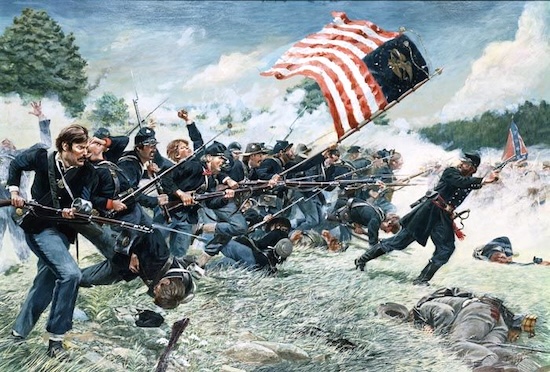
It was the most famous suicide charge in the history of the United States Army. Hancock later said:
“The superb gallantry of those men saved our line from being broken. No soldiers, on any field, in this or any other country, ever displayed grander heroism.”
The next day, with some of the wounded back in action, the First suffered another 55 casualties while repulsing Pickett’s Charge. After Gettysburg, the First Minnesota effectively ceased to exist.
John Phelan quotes one man who said that he enlisted in the First to fight under “the only flag worth dying for.” Those were no idle or hyperbolic words. If you go to the Minnesota State Capitol today, you can still see the flag, tattered and bullet-riddled, that the men of the First Minnesota carried down the hill at Gettysburg.
So, over this Independence Day weekend, when you remember the heroes of American history, spare a thought for the men of the First Minnesota.
A final note: John Phelan’s article on the First Minnesota is included in his collection of essays on Minnesota history, Star of the North, which you can buy at Amazon. American Experiment has published Star of the North as part of our observance of America’s 250th anniversary.
