Defending the Founders
February 22, 2018 — Scott Johnson

Today we celebrate the anniversary of the birth of George Washington. Of all the great men of the revolutionary era to whom we owe our freedom, Washington’s greatness was the rarest and the most needed. At this remove in time, it is also the hardest to comprehend. Take, for example, Washington’s contribution to the Constitutional Convention of 1787. Washington’s mere presence lent the undertaking and its handiwork the legitimacy that
»
January 26, 2018 — Steven Hayward

We should be grateful to Ryan Cooper for acknowledging so forthrightly in The Week what has been obvious to conservatives for a long, long time—liberals really really hate the Constitution, because limited government is an impediment to their endless dreams of ruling over us more completely and fixing every human problem: “America’s Constitution is terrible. Let’s throw it out and start over.” Cooper makes five main points, some of which
»
November 2, 2017 — Scott Johnson
This morning we resume our preview of the new issue of the Claremont Review of Books. Thanks to our friends at the Claremont Institute, I read the new issue in galley to select three pieces (this week I have five because I have three today) to be submitted for the consideration of Power Line readers. As always, wanting to do right by the magazine and by our readers, I had
»
July 4, 2017 — Scott Johnson
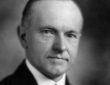
President Calvin Coolidge celebrated the 150th anniversary of the Declaration of Independence on July 4, 1926, with a speech providing a magisterial review of the history and thought underlying the Declaration. His speech on the occasion deserves to be read and studied in its entirety. The following paragraph, however, is particularly relevant to the challenge that confronts us in the variants of the progressive dogma that pass themselves off today
»
July 4, 2017 — Scott Johnson

On July 9, 1858, Illinois Senator Stephen Douglas gave a campaign speech to a raucous throng from the balcony of the Tremont Hotel in Chicago. Abraham Lincoln was in the audience as Douglas prepared to speak. Douglas graciously invited Lincoln to join him on the balcony to listen to the speech. In his speech Douglas sounded the themes of the momentous campaign that Lincoln and Douglas waged that summer and
»
April 23, 2017 — Steven Hayward

It was 20 years ago that Thomas G. West, nowadays the Potter professor of politics at Hillsdale College, published Vindicating the Founders: Race, Sex, Class, and Justice in the Origins of America. The book was a tour de force against the left’s relentless attacks on and distortions of the American founding, and it is an indispensable reference book for every one of the left’s clichés about the supposed defects, if
»
March 13, 2017 — Steven Hayward
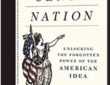
Thomas Jefferson’s famous 1825 letter to Richard Henry Lee explained that the Declaration of Independence was intended to express “the common sense of the subject, in terms so plain and firm as to command their assent. . . an expression of the American mind.” Common sense today is increasingly uncommon, especially when it comes to understanding what the Founders meant by “equality.” (Or maybe the left understands exactly what the
»
January 3, 2017 — Steven Hayward
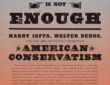
Anyone who would like to get a head start on a certain book that is being published next month (and which you can pre-order now, right here!—hint, hint) can find an excerpt in the new issue of National Affairs under the title “Two Kinds of Originalism.” This is adapted from Chapter 7 of the book, which is sure to sell out (so order early). The complete book chapter is longer
»
December 4, 2016 — Steven Hayward
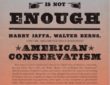
Scott kindly mentioned my forthcoming book, Patriotism Is Not Enough, which will appear in mid-February (though you can pre-order today!). I’m going over the final page proofs right now, and thought I might as well share a couple of previews. The book centers around, but is not confined to, the story of Harry Jaffa and Walter Berns, two of the great thinkers of the late 20th century. I’m one of
»
July 4, 2016 — Steven Hayward

Not sure whether I shared this Remy video back in 2003 when it came out, but it’s worth running again on this July 4, as a healthy reminder to annoy liberals everywhere by grilling your beef rare, drinking domestic beer (from a can—bonus points), waving the flag, and enjoying fireworks.
»
July 4, 2016 — Steven Hayward
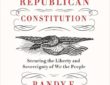
Randy Barnett, currently professor of law at Georgetown Law School, is one of the most important constitutionalists today. His latest book, Our Republican Constitution: Securing the Liberty and Sovereignty of We the People, will have a long shelf life as an important treatise on constitutional originalism. Barnett is all the more interesting for having come to his interest in constitutional law indirectly. As he explained in a previous book (Restoring
»
June 13, 2016 — Steven Hayward

Back in April I noted that the liberal culturati were unhappy over the success of the Broadway smash Hamilton, precisely because its multiracial cast and hip-hop format don’t conform to or reinforce the identity politics frame of the Left. Broadway is making a capitalist dead white guy look cool! Horrors! With Hamilton dominating the Tony Awards show last night, the New York Times returned to the theme as if to
»
May 19, 2016 — Steven Hayward

Given the lack of confidence in either of the two major party presidential presumptive nominees, earlier today I tweeted out the following thought-provoker: What prompted this was a passage from another old unpublished lecture of Harry V. Jaffa from 1996 that I happen to have found during recent book research: [Madison] believed that the statesmanship of the wise and the good that went into the architecture of the Constitution would
»
September 14, 2015 — Steven Hayward

Bernie Sanders’ appearance at Liberty University today made clear that he’s no independent socialist, but in fact a true-blue Democrat of the Stephen Douglas variety. John took note of these remarks already, but they deserves a bit more gilding: And I will also say, that as a nation — the truth is a nation that in many ways was created, and I’m sorry to have to say this from way
»
September 11, 2015 — Steven Hayward

When Harry Jaffa and Walter Berns died on the same day back in January, I wrote an article for the Wall Street Journal about how despite their bitter feud, they both deserve credit and praise for reviving some essential aspects of the American Founding. Their shared contributions were overshadowed by the rancor of their feud that spilled out from private letters into public forums. “In your present state of mind,”
»
September 5, 2015 — Steven Hayward

For any of our Bay Area readers who are bored and looking for an anthropological diversion on this fine Labor Day weekend, the American Political Science Association is having its last full day of panels and silliness. You, too, can can enjoy panels such as: Race, Gender, Sexuality, and Sexual and Domestic Violence in the NBA and NFL. Save up! But at 4:30 pm this afternoon I’ll be on a
»
August 28, 2015 — Steven Hayward

One of my fellow cruisers on the Baltic Sea last week was Seth Lipsky of the New York Sun, who wrote a terrific column about 10 days ago for the New York Post arguing that since Democrats are giving up on Thomas Jefferson and Andrew Jackson (because, at bottom, Democrats dislike and/or are ashamed of America’s history), Republicans ought to steal Jefferson away from them. Of course, Lincoln already did
»
